Friday, October 18, 2013

The Utility: Progress on the 2nd set of chine strips

Fairing these additional chine strips is coming along pretty quickly. Here are a couple of iPhone shots to show progress on the starboard side.

Faired flush with the side of frame #1.
A little more work is needed to blend the ends into the curvature of the chine. It's getting close, though.

Tuesday, October 15, 2013

New plywood & more chine fixes.

With G7 over, it was time to get back to work on the boat. 

In early October, I placed my order for 5 sheets of 1/4” BS 1088 Meranti Hydtrotek with Homestead Hardwoods in Ohio. I received my well-packaged crate of plywood just a few days later. Right off, I was more impressed with the Hydrotek than the Douglas Fir marine plywood I’d been using up to this point. The Meranti has a more attractive appearance, and a much smoother surface. It is also a 5-ply structure, rather than 3-ply like the Fir, so the outer and center plies are considerably thinner. I’m looking forward to using it to plank the boat, although I’ve read that Meranti splinters considerably when it is cut... we’ll see.


My crate of Meranti Hydrotek, fresh off the truck.
 
BS 1088 Meranti Hydrotek
Before I can plank the boat, though, I still have to finish fairing the framework. That means I have to deal with another problem along the chines.

Originally, I had cut 1” deep notches in the frames to receive the chine logs. However, the “1-inch” board I bought for the chines was in reality only 3/4” thick. This turned out to not be a problem, everywhere except frame #1. At frame #1, the chines ended up being recessed too deeply into the frame notches, leaving 1/4” of the frame extending past the chines on the sides of the boat.

1/4" of frame #1 extends past chine log.

1/4" of frame #1 extends past chine log.

Originally, my plan was to simply fair the frames inward to meet the chines. I changed my mind, however, and decided to laminate on a little extra material to this section of the chines, much like I did up forward. 

I cut two strips of 1-3/4” x 4’ Southern Yellow Pine from the most vertical-grained board I could find at Lowes. I planed these by hand down to roughly 3/8” thickness, and attached them with thickened epoxy , centering them with the 2’ mark in the middle of the frame. The next step is to fair these strips down to shape so that they form a fair curve along the length of the chine. Hopefully I can begin to plank the boat not long after that.


Dry fitting the 1-3/4" x 4' strips into place.
The port side strip clamped on while the epoxy cures.

Next step is to fair it down.


Monday, September 30, 2013

Glen-L Gathering 2013

Leave my cares at the dock? Done.

There was an old Chris-Craft ad from the 1960’s I stumbled across online not long ago. I don’t remember which model it was advertising (an early fiberglass runabout, I believe), but I do remember the tagline: “Leave your cares at the dock.”

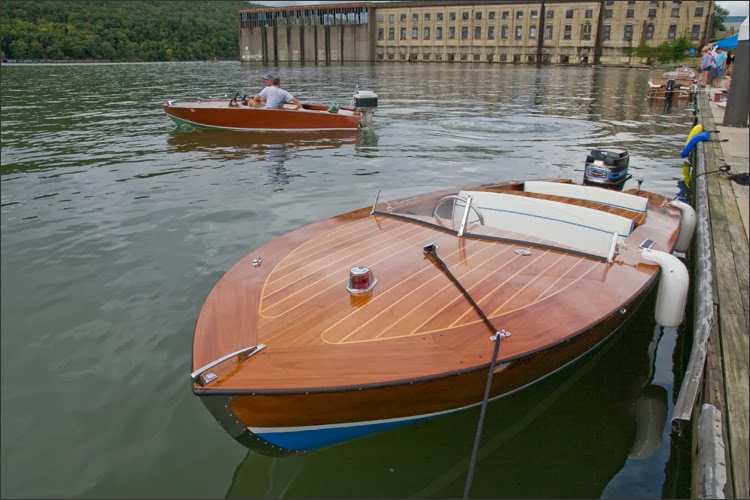
Leave my cares at the dock. That’s exactly what I’d been wanting, and needing to do for weeks. So I did just that — I left my cares at the dock. After all, Sept. 20 was G7 weekend, and the Glen-L boatbuilders were back in town. What better way to relax than riding in hand-made classic boats?

This is now the third Glen-L gathering I’ve attended. Each year brings a little something new. This year, for me, it was an eye-opening lesson in fuel consumption. I simply had no idea just how quickly an outboard motor will use up a full tank of fuel when it’s pushing a boat fully-laden with adults up & down the river for any distance. Wow! I tell you, it makes me all the more grateful to the kind people who took me out for rides in their boats.

This year I rode in a couple of beautifully-finished Zips. I got some ideas to possibly use on my own. I also rode in a very nice Monaco, and in Bob Brandenstein’s splendid Malahini. There was a tent sale this year, and after the gale-force winds Saturday morning (which I luckily missed), I bought a pair of cleats & a U.S. Yacht Ensign flag for the Utility. 


I also bought a bell. My daughter’s been asking me to put one on the boat since I first laid the keel. She saw the bell at the tent sale & just HAD to have it... so I bought it. 

For now I use it to wake her & her brother up for school.


Buddy's highly-modified Zip race boat.

There were several Zips at the Gathering this year.

Docking all these handmade wooden boats in Chattanooga.


1959 Mercury Mark 35A on Garfield's Zip.


I was really intrigued by Garfield's Zip, and all the unique, "out-of-the-box" thinking he put into it.

Paul brought his super-fast Hot Rod all the way down from Quebec

Bob's splendid Malahini.

Jeff Peters' newly-built Zip is adorned with original hardware off of a classic Century boat. I really like his distinctive mermaid fenders.

Monday, September 9, 2013

More fairing on the Utility. This time, the transom.

Warm greetings from Barnacle Mike’s crowded little boat shop. You know, one of the great things about the boatbuilding community is the fact that you meet some really cool people, both online and in person. The level of support and insight that you get from more experienced builders who kindly share their knowledge and give advice can truly help a newbie keep pushing his or her project forward. I’m very thankful for that.

An online boatbuilding friend, who has also been kind enough to follow my blog, sent me an e-mail the other day asking about the status of the Utility. It does seem like I’ve been paying a bit much attention to the Zip project lately. Truth is, I have still been slowly, slowly... s-l-o-w-l-y... fairing away at the Utility all the while. Still, his inquiry about its status gave me a little more motivation to get off my “transom” and put more elbow grease into getting the little boat past the fairing stage. (Thank you, Paul!)

So, that’s just what I did Saturday, fairing away at the transom sides until they were finished. The starboard side had a bit more excess material than the port side. So, I roughed it in with the belt sander, then worked it the rest of the way down with the mouse sander. Unfortunately, I did not follow the “best practice” of checking my work frequently with my test piece of plywood. (I thought the transom sides would be a no-brainer. I was wrong.) When I tested my “finished” work with the plywood, expecting to feel a broad smile cross my face as I witnessed my handiwork, I was disappointed to see several gaps appear. The culprit was an overly sharp bevel in a couple of spots. More gaps to fill with thickened epoxy. I’m getting pretty good at that, if I do say so myself.

Needless to say,  I was more cautious with the port side. I also went about it a little differently. This time, I started by carrying the line of the sheer and chine through the transom material first. Then, I “connected” the two spots by fairing the area in-between. This time I alternated between the mouse sander and a small block plane. I worked slowly and purposefully.

The results were much, much better.

I do still have a good bit more fairing to do, primarily in the mid-section of the boat. I also have to make a decision about the chines in that area, (more on that later). I could’ve worked on all this Sunday. However, yours truly decided he needed some time on the water. So, I spent the day canoeing. I’m sure you understand.

By the way, I met another boatbuilder out on the river. He was piloting a very nice-looking red drift boat upriver. It looked about 16’ long. The handsome-looking boat glided smoothly through the water, pushed by a silent electric trolling motor. He proudly said “yes” when I asked if he’d built it himself. He had some very nice things to say about Don Hill’s drift boat plans before we each went our separate ways. 

Yep. You’ve gotta love the boatbuilding community.

Starboard transom-chine joint after fairing.

Starboard transom-chine joint after fairing.
Starboard transom-chine joint after fairing

Starboard transom-sheer joint after fairing. As you can see, I've got a heck of a gap in that "Marine-Grade" plywood that I'm going to have to fill.


Port transom-chine joint before fairing.

Port transom-chine joint before fairing.
Port transom-chine joint after fairing.

Port transom-sheer joint before fairing. Notice all that epoxy thickened with #2 silica?

Port transom-sheer joint after fairing. I still have some thickened epoxy to file away.


Tuesday, August 20, 2013

Drawing out the next major Zip part

At first glance, the Zip has some rather odd frame designations.... Specifically, frame number "5-1/2".

It seems odd until you understand that the designations are logically based on boat design drawings. If you look at a cross-section drawing of the boat, there are several vertical lines that divide the hull into sub-sections. Each one of these vertical lines is called a "station." The numbering starts at zero (the transom), and ends at "F.P." (which stands for "Forward Perpendicular") at the foremost tip of the boat. In the case of the Zip, there are 8 stations including "F.P.", dividing the hull into 7 sub-sections of about 24-1/2" each. Frame # "5-1/2" is the frame placed between stations 5 and 6. It is located near the base of the stem.

Frame number 5-1/2 is a very important part. As the instructions indicate, the horizontal line formed by the floor member of frame # 5-1/2 is the plane from which the rest of the boat is set up. The instructions specifically state to take extra care to ensure that this part is accurately measured and constructed.

I just finished drawing this part, and I thought it would make a good blog post to illustrate how the Glen-L plans are copied to the wood.

First of all, you fold the carbon paper in half, so that the lines you trace through it are transferred to both the wood AND the back of the actual plans. Then you place the plans on the wood, and flatten them down securely. Push pins help for this.

Secondly, trace the plans for the part you want to build. As I mentioned in an earlier post, the centerline is THE crucial reference point for the boat. ALWAYS carefully draw the centerline. Make sure you extend your traced centerline beyond the needed dimensions of the part, for this reason:

Third, draw "sight holes" that are centered on the extended part of the traced centerline. I like to trace a small coin for this purpose. Use an exacto knife to cut your sight holes through the paper. You'll need these holes to align the plans after you flip them over.

Here I've traced out the floor timber, and have cut sight holes on the centerline.
Next, remove your push pins, plans, and carbon paper from the wood. The half-width of your part should be clearly visible.

Half-width of the floor timber drawn onto 3/4" Douglas Fir marine plywood.
Now, un-fold the carbon paper, and place it normally onto the wood where the second half of your part is to be drawn. Flip the plans over, and you'll see the carbon-copy you made on the back of the plans. Carefully and accurately align the sight holes on the extended centerline that is traced onto the wood. Again flatten the paper down securely. Now you're ready to trace the second half.

Plans flipped & aligned. Ready to draw the second half of the floor timber.
Trace the carbon-copied lines onto the wood, just like you did the first side. When you're done, the full part will be drawn onto the wood.

The full floor timber drawn onto the wood, waiting to be cut out.

Monday, August 19, 2013

Still fairing

The long, slow and laborious process of fairing continues. I was happy that over the weekend, I did make port and starboard contact at the bow. Although it's hard to tell if it's just the angle of the photo, it looks like I need to balance the symmetry of the joining sheer lines. I also have a small gap there on the front starboard side that I need to fill with epoxy.

The great news is, even though fairing is taking a long time, it is getting closer to being done.


Monday, August 12, 2013

Zip stem construction

Today's blog post is about assembling the stem for my Glen-L Zip. The Zip's stem, as with many Glen-L designs, is made from two identically shaped pieces of 3/4" marine-grade plywood, laminated together with marine epoxy and fastened with silicon bronze screws.

This is now the third stem I've built; the other two being for a Squirt and a Utility. Learning from previous experience, I did a few things differently this time.

First, I spent much more time and care in shaping the pieces beforehand. I feel very comfortable this time around with the shape being correct.

Second, I used less epoxy. The other two times, I globbed a bunch of thickened epoxy on, just to make certain there was enough. In reality, that just creates more of a mess, because the majority of it squeezes out.

Third, I kept a putty knife ready to scrape away the epoxy that squeezed out from between the two layers of plywood. This makes for much less sanding afterwards.

Also, having learned a tip from a fellow boatbuilder, I used an awl to quickly align the pre-drilled holes before driving the screws back in. This proved to be a great time-saver, since it can be a little tricky to mate the holes back together with epoxy spread over the wood, (particularly while wearing latex gloves, goggles, and a respirator).

For the epoxy, I used Glen-L Poxy Shield, thickened slightly with #2 silica. Poxy-shield is mixed in a 5:1 ratio, using 5 parts resin to 1 part hardener. It can be hard to find very small mixing cups in order to measure small batches of epoxy, so I've used my own method. I take a regular off-the-shelf mixing cup, and measure the distance between the pre-printed volume marks. So far, all the cups I've used had a distance of 8mm between the 4oz and 8oz markings. So, I add marks every 2mm between them to show the 5oz, 6oz and 7oz lines. That way, I can pour in 5oz of resin, then add hardener until the mixture reaches the 6oz line. There are, no doubt, more accurate ways to go about this. However, this way is quick, simple, cheap, and effective.

Perhaps not the most scientific method, but it works.
After mixing and thickening the epoxy, I spread it out on the mating surfaces of each stem piece, making sure the whole area was covered. Then, I put the pieces together & aligned a couple of holes with the awl. I dipped the silicon bronze screws in a little epoxy, then drove them down into the holes. Then, I clamped the pieces together solidly, driving the screws in further as needed. Afterwards, I scraped away the epoxy that had squeezed out from between the layers before the epoxy became unworkable. Then I left it alone to let the epoxy cure overnight.

Everything ready to go: Stem parts, Poxy-Shield resin and hardener, #2 silica, mixing cups, mixing stick, chip brush, awl, screwdriver, extra screws (just in case), clamps, and putty knife.

Glued, screwed, clamped and scraped with the epoxy curing.

On a final note, I also worked on the Utility over the weekend... still fairing. It seems like a never-ending process, but it's getting there.